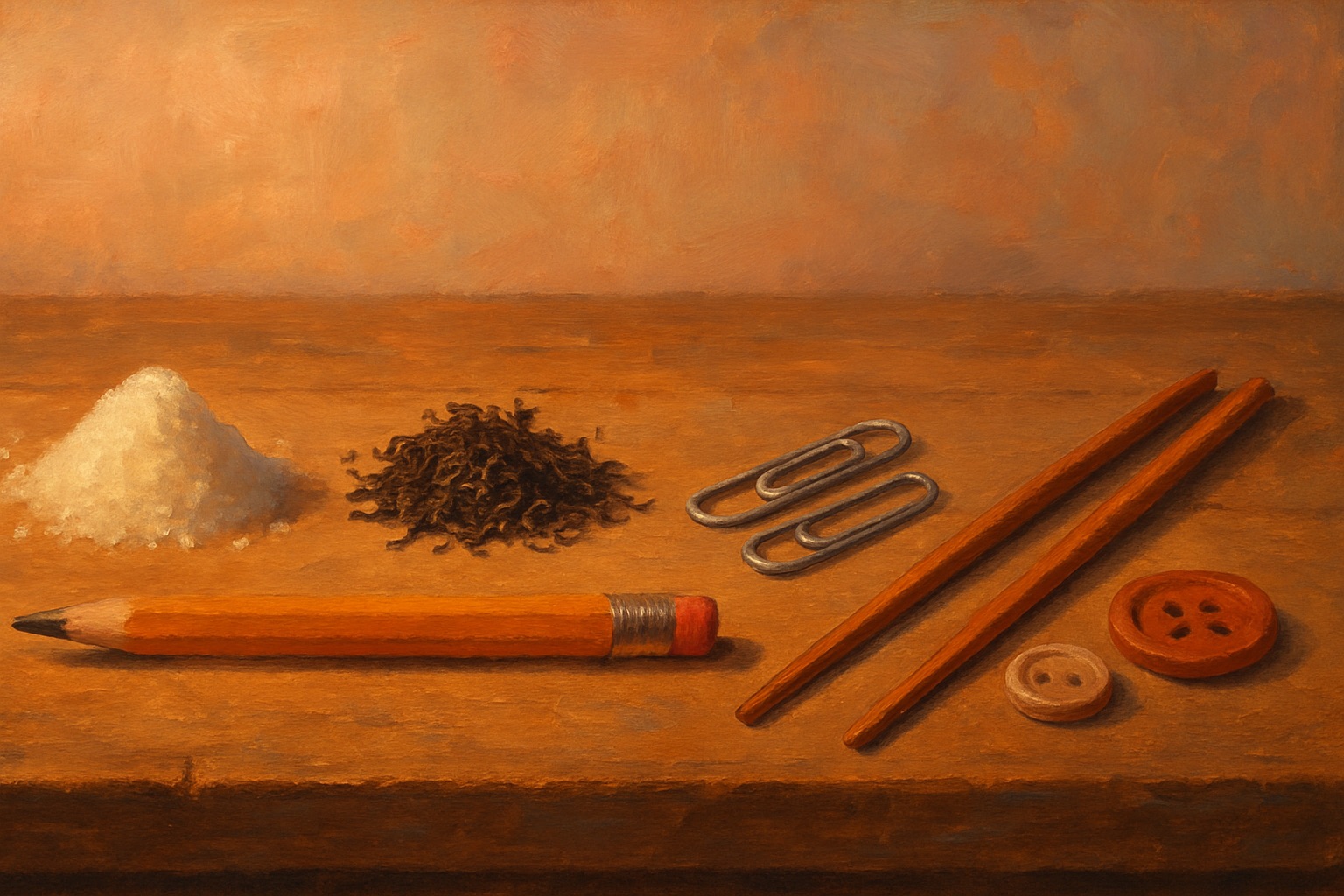
Empires have risen and fallen over things you can buy today for pocket change. Here is the outsized history hiding in the most ordinary stuff you own.
Salt built roads, stoked a revolution, and defied an empire.
Rome's Via Salaria was literally the Salt Road, resentment of France's hated salt tax helped fuel the Revolution, and Gandhi chose salt for his great 1930 march against British rule. The word salary even traces to the Roman salarium — though the tale that legionaries were paid in salt is one historians doubt.
Tea triggered conflict on two continents.
Britain's tea habit drained so much silver to China that it pushed opium instead, helping spark the Opium Wars — and taxed tea so clumsily that Boston Harbor got an expensive new flavor in 1773. Then botanist Robert Fortune smuggled tea plants and know-how out of China in the 1840s, breaking the monopoly and remaking India's economy.
The pencil was born from a guarded, smuggled treasure.
When a huge deposit of pure graphite turned up in Borrowdale, England, in the 1500s, it became so valuable the mines were guarded and the stuff was smuggled like contraband. When war later cut France off from English graphite, Nicolas-Jacques Conté invented the clay-and-graphite blend in 1795 that is still inside nearly every pencil today.
The paper clip became a symbol of wartime resistance.
During the Nazi occupation of Norway, citizens wore paper clips on their lapels as a quiet pledge to stay bound together — and risked arrest for it. Bonus twist: the familiar looped Gem design was never patented, and the Norwegian long credited with inventing it actually patented a different clip entirely.
Buttons existed for thousands of years before anyone cut a buttonhole.
Ornamental buttons show up in the Indus Valley more than four thousand years ago, but the functional buttonhole only reached Europe around the 13th century. That one slit revolutionized clothing, making fitted garments possible for the first time.
Chopsticks started as cooking tools, not eating utensils.
Bronze chopsticks from around 1200 BC were used to pluck food from pots of boiling water, and they only became standard tableware centuries later. Tradition ties the knife-free table to Confucian ideals about keeping instruments of slaughter away from the meal — a story scholars still debate.
Black pepper was once literal ransom money.
When Alaric the Visigoth besieged Rome in 408 AD, his price for sparing the city included 3,000 pounds of pepper. The hunger for pepper and its cousins later helped launch the entire Age of Exploration.
Paper was a trade secret that took centuries to escape China.
Papermaking was standardized there by 105 AD, credited to the court official Cai Lun. The leading story holds that Chinese papermakers captured at the Battle of Talas in 751 carried the craft into the Islamic world — and Europe still did not produce its own paper for centuries after that.
The umbrella was once too embarrassing for a man to carry.
When Jonas Hanway carried one through 1750s London, he was mocked — and, the story goes, pelted by coachmen who saw it as both unmanly and a threat to their rainy-day fares. Within a generation, umbrellas were everywhere.
The fork was denounced as scandalous vanity.
When a Byzantine princess brought her golden forks to Venice around the year 1004, clergymen condemned the utensil as decadent — and when she later died of plague, one churchman called it divine judgment. Forks did not become normal across most of Europe for another six hundred years.
Mirror-making secrets were guarded like state weapons.
Venice confined its master glassmakers to the island of Murano and treated leaving with trade secrets as a crime against the Republic — with legends of assassins sent after defectors. France lured mirror-makers away anyway, and the result glitters in the Hall of Mirrors at Versailles.
Playing cards were deadly serious tax business.
In England the ace of spades carried the official duty stamp, which is why it got the elaborate design it still wears. Forging that ace was a capital crime — one forger, Richard Harding, was hanged for it in 1805.
Respect to the fork, which needed six centuries to live down one banquet.