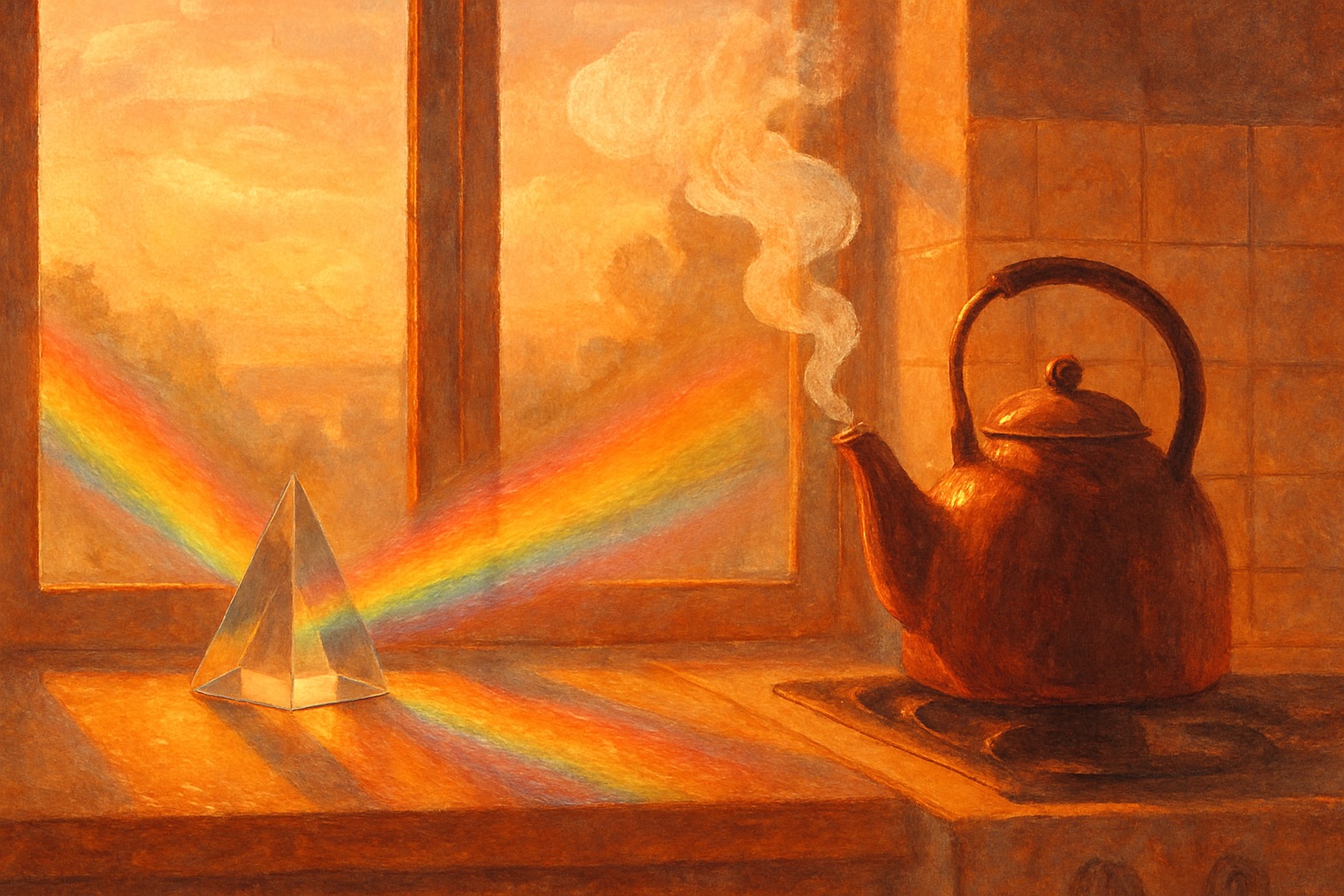
You don't need a lab to watch physics show off — a kitchen, a bathroom, and a window will do. Here are eleven ordinary sights doing extraordinary science right in front of you.
The sky is blue because air itself scatters sunlight.
Air molecules scatter short wavelengths far more than long ones — Rayleigh scattering — so blue light gets bounced all over the sky before reaching your eyes. Violet actually scatters even more, but the sun emits less of it and our eyes barely register it, so blue takes the credit.
Mirrors don't actually flip left and right — they flip front and back.
A mirror reverses the axis pointing into it: your reflection is you turned inside-out, front-to-back. It only feels like a left-right swap because your brain imagines walking around behind the glass to stand in the reflection's place.
Your microwave heats food by yanking water molecules back and forth.
Water molecules are electrically lopsided, so the oven's alternating field — flipping about 2.45 billion times a second — makes them jostle their neighbors, and that jostling is heat. The popular claim that this is water's resonant frequency is a myth; true resonance would cook only the outer millimeter.
Glass is transparent because its electrons are picky eaters.
Visible-light photons don't carry enough energy to excite the electrons in glass, so they sail through as if nothing were there. Ultraviolet photons do carry enough — which is why window glass blocks a good chunk of UV.
Ice floats because freezing water builds itself a cage.
As water freezes, hydrogen bonds lock the molecules into an open hexagonal lattice that's roughly 9 percent less dense than the liquid. That quirk makes lakes freeze from the top down — and lets fish spend winter alive underneath.
A kettle is loudest right before it boils — then goes quiet.
Early on, steam bubbles form at the hot bottom and violently collapse in the cooler water above, and those tiny implosions are the roar. At full boil the bubbles survive all the way up, and the racket drops to a polite burble.
The shower curtain attacks you — and scientists still argue about why.
A 2001 computer simulation suggested the spray drives a sideways vortex whose low-pressure core sucks the curtain inward, work that won an Ig Nobel Prize. Competing explanations involving rising warm air and Bernoulli effects still have their defenders.
Soap bubble swirls are light interfering with itself.
Light bouncing off the outer and inner surfaces of the soap film recombines, canceling some colors and boosting others depending on the film's thickness. When patches of a bubble turn colorless and dark, the film has thinned to near nothing — it's about to pop.
That shimmering puddle on a hot highway is actually the sky.
Air just above sun-baked asphalt is hotter and less dense, so it bends light from the sky upward into your eye — an inferior mirage. Your brain, reasonably enough, interprets sky-on-the-ground as water.
Clouds are white because their droplets are chunky.
Cloud droplets are far bigger than a light wave, so they scatter all colors about equally — and all colors together is white. A storm cloud's dark base is just sunlight failing to fight its way through.
Stars twinkle. Planets mostly don't.
Stars are so far away they're effectively single points of light, and turbulent air jiggles a point around easily. Planets are tiny disks, and the jiggling across the disk averages out into a steady shine — an old stargazer's trick for telling them apart.
And yes, that means every mirror you've ever blamed for swapping your left and right was innocent all along — the flip was in your head.