History loses things constantly — to shipwrecks, wars, and forgetful burials. The good news: every so often, spectacularly, it gets them back.
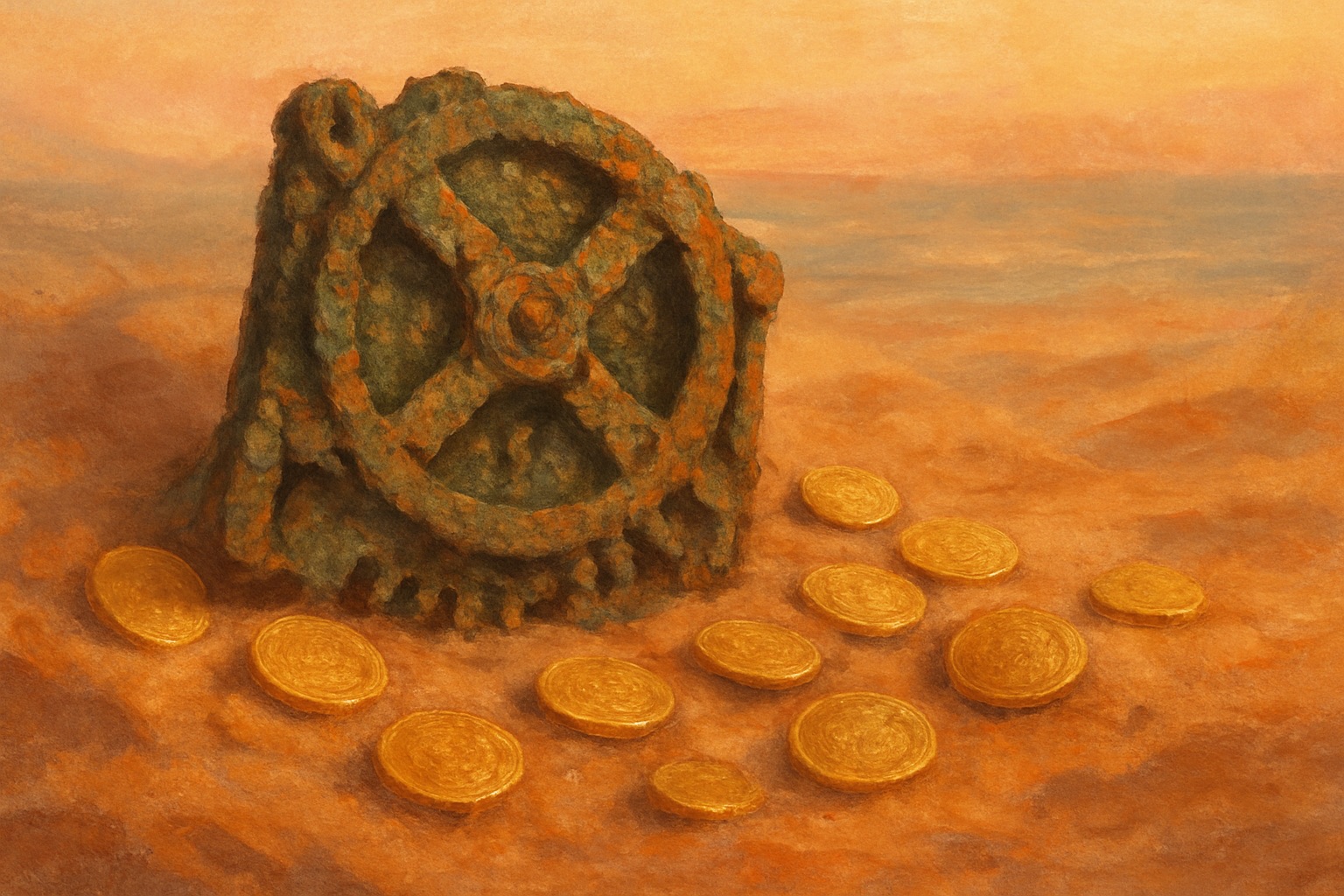
Sponge divers hauled up a 2,000-year-old computer.
In 1901, Greek sponge divers exploring an ancient shipwreck off Antikythera recovered a corroded lump of bronze that turned out to be a geared machine for predicting eclipses and tracking celestial cycles. Nothing of comparable mechanical complexity appears in the record for well over a thousand years afterward.
The 'holy grail of shipwrecks' sat off Colombia for 300 years.
The Spanish galleon San José went down in battle in 1708 loaded with gold, silver, and emeralds, and was finally located in 2015 by an underwater robot. Value estimates run into the billions — which is why Colombia, Spain, and a U.S. salvage company are still fighting over it.
The largest Anglo-Saxon gold hoard ever found came out of an ordinary farm field.
In 2009, metal detectorist Terry Herbert got permission to sweep a friend's farmland in Staffordshire and started pulling up seventh-century gold — ultimately thousands of fragments, nearly all of it war gear like sword fittings. The hoard was valued at £3.285 million, split between detectorist and farmer.
China's Terracotta Army was found by farmers digging a well.
In 1974, farmers near Xi'an struck pottery fragments that led archaeologists to an estimated 8,000 life-size clay soldiers guarding the tomb of China's first emperor, Qin Shi Huang. The heads were assembled from molds and then individually hand-finished, which is why the faces seem endlessly varied.
The Dead Sea Scrolls announced themselves with the sound of breaking pottery.
In late 1946 or early 1947, a young Bedouin shepherd tossed a stone into a cave near Qumran and heard a jar shatter — inside were manuscripts that proved roughly a thousand years older than the oldest previously known copies of Hebrew Bible texts. Four of the scrolls were later offered for sale through a classified ad in the Wall Street Journal.
Britain's greatest Roman treasure turned up during a search for a lost hammer.
In 1992, a Suffolk farmer asked friend Eric Lawes to bring his metal detector and find a mislaid hammer; Lawes instead found the Hoxne Hoard — nearly 15,000 Roman coins plus gold jewelry. The hammer was eventually found too, and it's in the British Museum alongside the treasure.
An English widow dug up a buried ship on a hunch.
In 1939, Edith Pretty hired self-taught excavator Basil Brown to dig the mounds on her Sutton Hoo estate, and he uncovered a seventh-century Anglo-Saxon ship burial packed with royal treasure, including the famous helmet. Pretty donated the entire find to the British Museum.
Mel Fisher said 'Today's the day' every morning for 16 years.
The treasure hunter spent over a decade and a half searching for the Nuestra Señora de Atocha, a Spanish galleon sunk by a hurricane off the Florida Keys in 1622. On July 20, 1985, the motto finally came true: his crew found the main pile, worth an estimated $400 million.
Afghanistan's Bactrian gold spent decades presumed destroyed.
More than 20,000 gold pieces from 2,000-year-old nomad graves were excavated in 1978, then vanished into rumor during years of war — many assumed they'd been looted or melted down. In 2003, a sealed vault under the presidential palace in Kabul was opened, and the whole collection was still there.
A California couple's dog walk ended at $10 million in gold coins.
In 2013, a couple noticed a rusty can poking out of the ground on their property and unearthed eight cans holding 1,427 U.S. gold coins — face value around $28,000, market value roughly $10 million. Who buried them, and why, has never been established.
Tutankhamun's tomb was found on the final funded season.
After years of near-empty digging, Howard Carter's patron Lord Carnarvon agreed to bankroll one last season — and in November 1922 the team uncovered a staircase to the most intact royal tomb ever found in Egypt. Asked if he could see anything through the breach, Carter answered, 'Yes, wonderful things.'
We're finally reading scrolls that Vesuvius torched in 79 AD.
Hundreds of papyrus scrolls from Herculaneum's Villa of the Papyri were carbonized by the eruption — too fragile to unroll for over two centuries. In 2023, the Vesuvius Challenge used CT scans and machine learning to read words inside a still-rolled scroll, starting with the ancient Greek word for 'purple.'
Somewhere in the British Museum, a hammer sits near a Roman fortune — proof that the best treasure maps are just errands that went sideways.