You experience a thin slice of reality and call it the world. Meanwhile, the animals around you are tuned into channels you don't even receive.
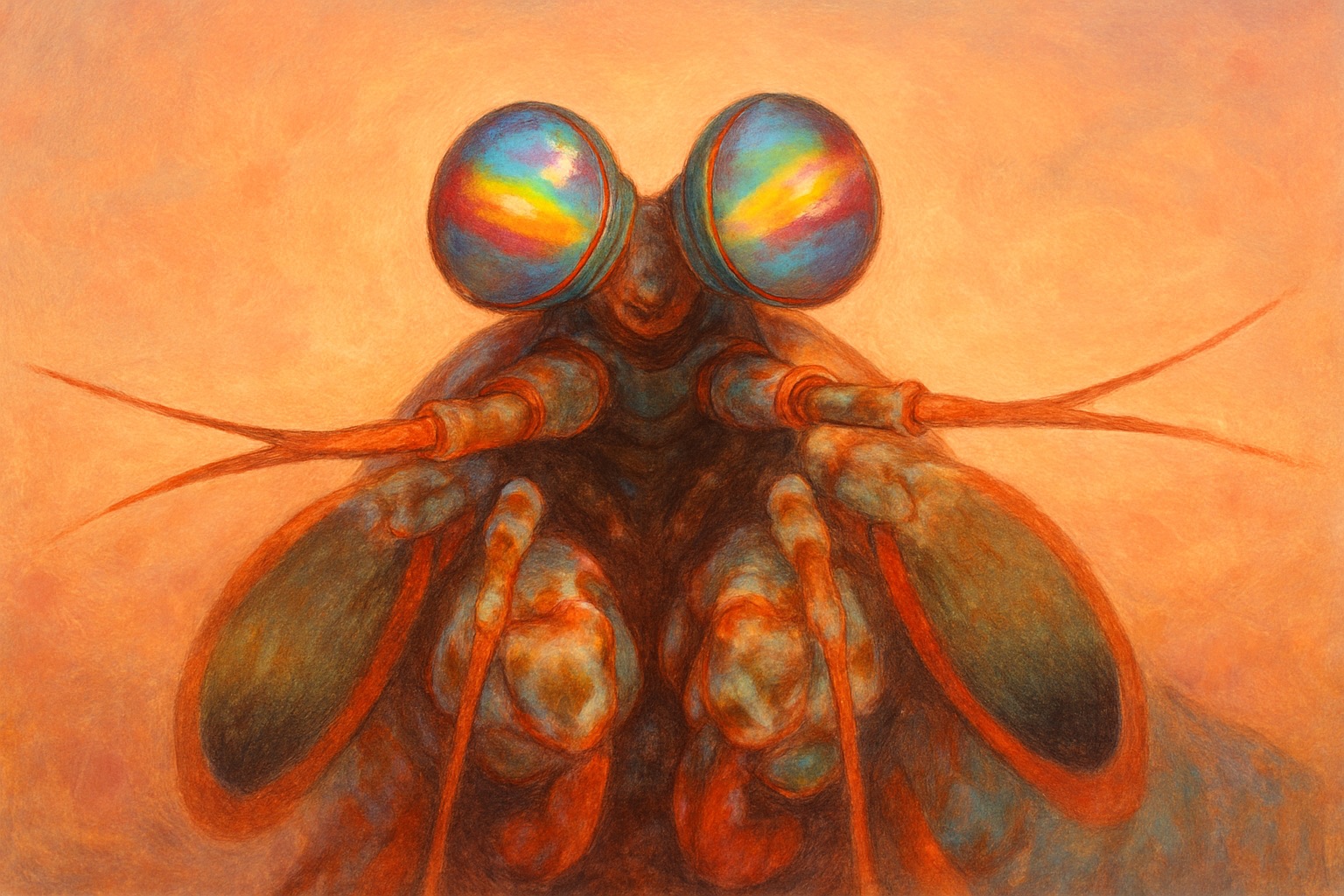
Mantis shrimp have up to 16 kinds of color receptors — and worse color discrimination than you.
Their extravagant eyes (we make do with three receptor types) made them the poster child for super color vision, until a 2014 study found they actually tell similar colors apart worse than humans do. Researchers now think their eyes skip fine comparison entirely and pattern-match colors at high speed — more scanner than painter.
A dog's nose is a time machine.
With some 300 million scent receptors to our roughly six million, dogs can detect certain odors at concentrations of parts per trillion and read a sidewalk like a timeline of who passed and when. Each nostril even samples the air separately, giving them smell in stereo.
Bats see with sound in total darkness.
Echolocating bats build a sonic picture sharp enough to detect a wire as fine as a human hair, adjusting their calls mid-flight as they close on prey. Some moths have evolved clicks that jam the sonar — an evolutionary arms race still in progress.
Migrating birds may literally see magnetic fields.
The leading theory involves light-sensitive proteins called cryptochromes in birds' eyes, which host a quantum-mechanical reaction sensitive to Earth's magnetic field — possibly overlaying a compass onto their vision. Researchers still argue about the mechanism, but the navigation itself is undeniable.
Pit vipers see heat well enough to strike blind.
Their facial pit organs detect temperature differences of a few thousandths of a degree, and their brains overlay that infrared picture onto normal vision. In experiments, a rattlesnake with its eyes covered can still strike a warm target accurately.
Sharks sense electricity measured in billionths of a volt.
Jelly-filled pores called the ampullae of Lorenzini pick up the faint electrical fields of a heartbeat or a twitching muscle, letting sharks find prey buried under sand. It ranks among the most sensitive electrical detection known in nature.
Bees see colors you can't — and can't see red.
Bee vision extends into ultraviolet, revealing bullseye nectar guides invisible on ordinary-looking flowers, while red reads as black to them. They also navigate by the sky's polarized light, a compass humans need instruments to read.
Elephants hear with their feet.
They rumble in infrasound below the range of human hearing, and the calls carry for kilometers through both air and ground. Elephants can pick up those seismic messages through sensitive tissue in their feet and trunks.
A catfish is a swimming tongue.
Its entire body is covered with more than 100,000 taste buds — several times what's in your whole mouth — densest around its whiskers. In murky water, it quite literally tastes its way to dinner.
The star-nosed mole eats faster than you can blink.
The 22-tentacled star on its face packs roughly 25,000 microscopic touch organs, letting it identify and swallow prey in a fraction of a second — among the fastest foraging ever measured. It can even smell underwater by blowing and re-inhaling air bubbles.
To a fly, you move in slow motion.
Flies perceive flickering light at several times the rate humans can, so fast events appear stretched out — one reason your swat never lands. A movie at standard frame rate would look to them like a slideshow.
Barn owls hunt in absolute darkness with lopsided ears.
One ear opening sits higher than the other, letting the owl triangulate sound vertically as well as horizontally. In lab tests, barn owls catch prey in complete darkness by hearing alone.
Seals read the water like a story.
A harbor seal's whiskers detect the swirling wake a fish leaves behind, and blindfolded seals in experiments have followed those trails long after the fish has passed. It is essentially reading footprints — in open water.
The mantis shrimp, meanwhile, would like everyone to know it never asked to be your poster child.