National cuisines feel eternal, but most of them are younger than the printing press — and built almost entirely on imported ingredients. Here are fourteen foods whose passports tell a very different story than their menus do.
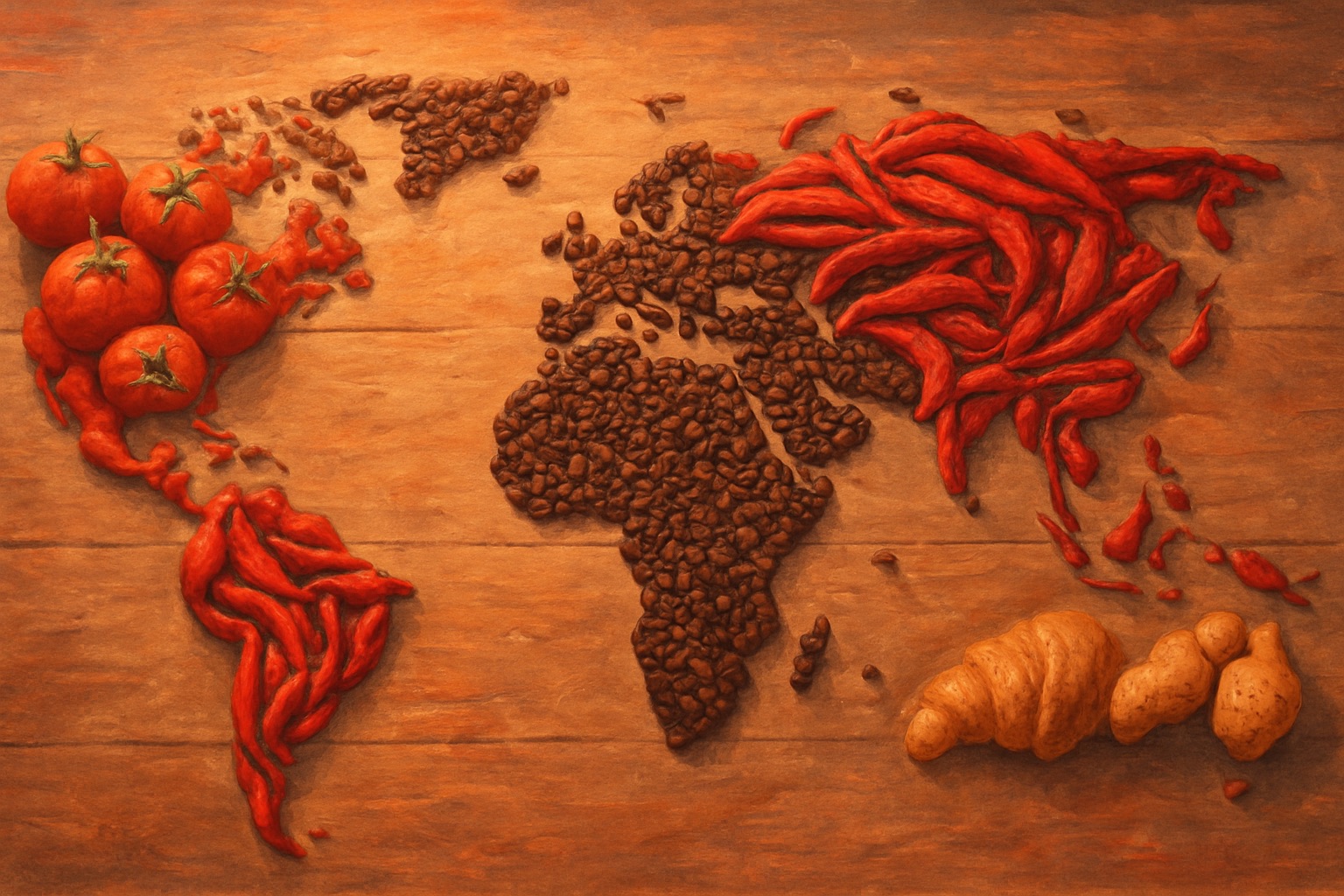
Tomatoes are from the Americas and didn't appear in Italian records until 1548 — and even then, Europeans mostly grew them as ornamental curiosities, wary of a plant from the nightshade family.
The Italian word pomodoro means “golden apple,” because early arrivals were yellow. Italian cuisine as the world knows it — red sauce and all — is a post-Columbus invention.
Chili peppers existed only in the Americas until the 1490s. Portuguese traders carried them to India and Asia, where they transformed entire cuisines within a century.
Thai curries, Sichuan hotpot, Indian vindaloo heat, Korean gochujang — none of it existed before 1500. Half the world's signature spice arrived on a boat.
The croissant descends from the Austrian kipferl and reached Paris around 1838, when Viennese baker August Zang opened his boulangerie there.
The romantic tale that it was invented to celebrate defeating the Ottomans at Vienna in 1683 — crescent moon and all — has no solid historical evidence behind it. France's most French pastry is an Austrian import with a good publicist.
Tempura came to Japan with Portuguese missionaries and traders in the 16th century, likely descending from fried Lenten dishes like peixinhos da horta — battered green beans.
Even the name probably comes from Latin: “tempora,” the Catholic fasting days when meat was off the menu and frying vegetables was the workaround.
General Tso's chicken was created by Hunan-born chef Peng Chang-kuei in Taiwan in the 1950s, then re-engineered sweeter for New York palates in the 1970s.
General Tso himself died in 1885 and never tasted it — and when documentarians brought the dish to his hometown in Hunan, locals didn't recognize it at all.
Coffee is native to Ethiopia and was first reliably documented as a brewed drink among Sufi communities in 15th-century Yemen, spreading through the port of Mocha.
The famous tale of Kaldi the goatherd and his dancing goats is charming — and almost certainly legend. The Sufis, though, are documented: coffee's first fans drank it to stay awake for midnight prayers.
Potatoes were domesticated in the Andes thousands of years ago, and Europe spent two centuries deeply suspicious of them. French pharmacist Antoine-Augustin Parmentier — who'd survived on potatoes as a prisoner of war — made converting France his life's mission.
As the story goes, he posted guards around his potato plot by day and withdrew them at night, betting that peasants would steal anything worth guarding. France now puts his name on potato dishes.
Nearly every banana exported worldwide is a Cavendish — a variety cultivated in the 1830s in a greenhouse at Chatsworth House in Derbyshire, England, and named for the Duke of Devonshire's family.
The global banana is genetically an English garden experiment — one that got its big break only after disease wiped out its predecessor, the Gros Michel, in the mid-1900s.
The domesticated apple's wild ancestor, Malus sieversii, still grows in forests in the Tian Shan mountains of Kazakhstan — and the city of Almaty's name is popularly linked to apples.
Apples walked the Silk Road to Europe, hybridizing with crabapples along the way. As American as apple pie, via Central Asia.
Ketchup began as ke-tsiap, a fermented fish sauce from southern China and Southeast Asia. British traders brought the idea home and made ketchups from mushrooms and walnuts; tomatoes only entered the picture in 19th-century America.
The most American condiment is a Hokkien fish sauce that lost the fish, gained a tomato, and kept the name.
Vindaloo isn't ancient Indian — it's Goan-Portuguese, an adaptation of carne de vinha d'alhos, meat marinated in wine vinegar and garlic.
Despite the sound of it, the original had no aloo (potato) at all. The name is mangled Portuguese, not Hindi.
Fortune cookies are Japanese, not Chinese — descended from tsujiura senbei, fortune-bearing crackers baked near Kyoto shrines, and popularized in California by Japanese immigrants.
When Japanese Americans were interned during WWII, Chinese restaurants took over production, and the cookie switched cuisines for good. San Francisco and Los Angeles still dispute who served it first. China had to have them introduced — marketed as “genuine American fortune cookies.”
The turkey is a North American bird that English speakers named after Turkey, apparently confusing it with birds arriving via Turkish merchants.
The Turks, equally confused, call it hindi — “from India.” The French agree: dinde, from d'Inde. An entire hemisphere of wrong guesses, permanently enshrined in dictionaries.
Marco Polo did not bring pasta to Italy from China. Sicily was producing dried pasta in the 1100s — the geographer al-Idrisi described it in 1154 — and a Genoese inventory lists macaroni in 1279, before Polo even returned.
The myth was largely popularized by a 1929 story in an American trade magazine, the Macaroni Journal. Pasta's origin story was, fittingly, an ad.
Every entry here is a solid passport stamp, but the turkey takes it: a bird so thoroughly mislabeled that two continents named it after two different countries, both wrong.